A missed bill usually does not happen because someone is careless. It happens because the due date lived in one email, the account login sat in another app, and the autopay setting was never quite as certain as it seemed. A good recurring bills checklist brings those loose ends into one place, so you can see what is due, when it repeats, and what still needs your attention.
If your bills feel scattered, the fix is not a more complicated system. It is a clearer one. The goal is to know which payments recur, how often they hit, and where to look before anything slips past you.
What a recurring bills checklist should actually do
A useful checklist is not just a list of company names. It should give you enough detail to act quickly when a bill is coming up. That means each item needs a due date, a repeat schedule, a payment method, and a simple note about whether it is on autopay or needs a manual payment.
That level of detail matters because recurring bills are not all the same. Some land on the same date every month. Others renew every year. Some are stable, while others change from cycle to cycle. If your checklist treats every bill the same way, it will still leave room for surprises.
The best version is one you can review in a minute or two and trust immediately. You should not have to check your bank app, search old emails, and scroll through text alerts just to confirm what is due this week.
The core categories to include in your recurring bills checklist
Start with the payments that affect your day-to-day life most directly. For most households, that means housing, utilities, phone service, internet, and subscription renewals. If you rent, include rent and renter-related services. If you own a home, include mortgage-related payments and recurring property expenses that hit on a monthly, quarterly, or annual basis.
It also helps to separate true bills from subscriptions. They may both recur, but they behave differently. Utility bills often vary in amount and need closer monitoring. Streaming services or software renewals are usually smaller, but easier to forget because they run quietly in the background for months.
A practical checklist often includes rent or mortgage, electricity, gas, water, internet, mobile phone, streaming services, cloud storage, memberships, school or child-related recurring fees, parking, and any annual renewals you know tend to disappear until the last minute.
The exact mix depends on your household. A single renter may have a short monthly list. A family managing multiple devices, services, and household accounts may have a much longer one. The point is not to copy someone else's categories. It is to capture the payments that regularly require your attention.
What information to track for each bill
For each recurring bill, record the company or service name first. Then add the due date and the repeat schedule, such as monthly, quarterly, semiannual, or annual. After that, note whether the bill is fixed or variable. This makes a big difference when you are reviewing upcoming payments.
You should also note the payment status setup. Is it on autopay, scheduled manually, paid by card, or paid from a bank account? If there is a grace period or a billing window instead of one fixed date, include that too. A short account note can also help, especially if the bill belongs to a specific family member or property.
What you do not need is a complex financial profile for each entry. A recurring bills checklist works best when it stays focused on visibility and follow-through. Keep it simple enough to maintain, but complete enough to trust.
Monthly bills need one kind of review. Annual renewals need another.
Most people think of recurring bills as monthly charges, but annual renewals are often the ones that cause more frustration. They are easier to forget, more likely to have changed in price, and often tied to services you may not even use much anymore.
That is why your checklist should not just be organized by type. It should also be organized by frequency. Monthly bills deserve regular review because they affect near-term cash flow and due dates. Annual charges deserve advance reminders because they can sneak up on you.
Quarterly payments sit somewhere in the middle. They are infrequent enough to be forgotten and frequent enough to matter. If you lump them into a general list without a repeat schedule, they can disappear until the next charge arrives.
How to build a recurring bills checklist that stays useful
A checklist only works if you keep it current. The easiest way to do that is to build it in one sitting, then make small updates as bills change. Start with your last one or two bank or card statements and pull out every recurring charge you recognize. Then cross-check with your inbox for renewal confirmations and payment notices.
As you build the list, do not stop at the obvious utilities. Look for smaller recurring charges that are easy to ignore. Those are often the ones that stay active the longest without much thought. If you share household expenses with a partner, compare notes so the checklist reflects the full picture rather than just the bills tied to one account.
After the first draft, sort each item by timing. Some people prefer to group by the date of the month. Others prefer monthly, quarterly, and annual sections. Either approach can work as long as it helps you spot what is coming next.
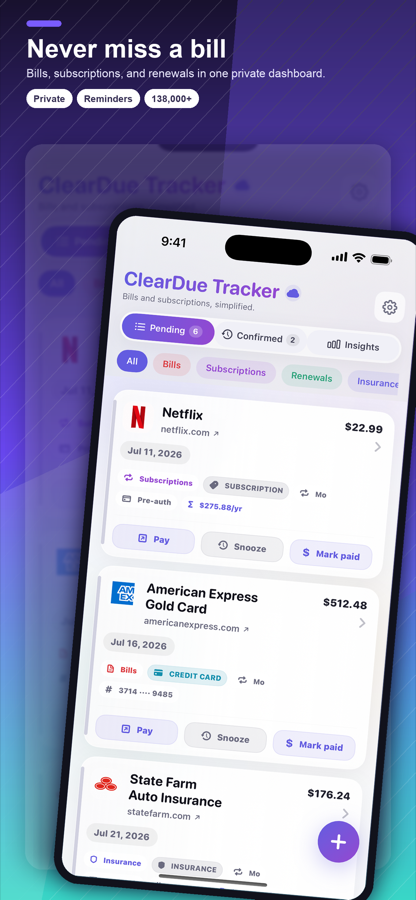
This is where a dedicated reminder tool makes life easier. Using ClearDue Tracker, iPhone users can keep recurring bills, subscriptions, and due dates in one place instead of spreading them across notes, calendars, and memory. That kind of visibility is often what turns a checklist from a one-time cleanup project into a system you actually use.
Common checklist mistakes that create more stress
One common mistake is listing bills without noting whether they are automatic or manual. That creates false confidence. A bill on autopay may still fail because a card expired or an account balance changed. A manual bill may look familiar enough that you assume it was handled when it was not.
Another mistake is tracking only the bill name and due date. That seems efficient at first, but it leaves out the details you need when a reminder appears. If you cannot tell how the bill is paid, whether the amount varies, or where the charge should come from, you still end up doing detective work every month.
The other issue is overbuilding. If your checklist becomes a full spreadsheet with too many fields, formulas, and color codes, it may look organized but be hard to maintain. For most households, simple visibility is more valuable than perfect complexity.
When to review your checklist
A recurring bills checklist does not need constant attention, but it does need regular review. A quick weekly glance helps you catch what is due soon. A slightly deeper monthly review helps you confirm billing changes, remove canceled services, and add anything new.
Annual renewals deserve their own look a month or so before they hit. That gives you time to decide whether to keep the service, update a payment method, or prepare for a larger charge. Without that lead time, annual bills often feel abrupt even when they were technically predictable.
It also helps to review after a life change. Moving, changing internet providers, adding a family phone line, switching cards, or starting a new subscription all affect your recurring payment picture. The checklist should reflect real life as it changes, not just the version of your household from six months ago.
Why this matters more than people think
Late fees matter, but they are not the only problem. The larger issue is mental clutter. When recurring bills live in too many places, you spend energy remembering what should already be clear. Even small uncertainties add up, especially when several due dates hit at once.
A checklist reduces that background noise. It gives you one reliable view of your recurring obligations, which is often enough to make the rest of the month feel more manageable. You stop wondering what you forgot and start knowing what is next.
That kind of clarity is useful whether your bill list is short or long. A renter with a few monthly payments benefits from the same structure as a busy household juggling utilities, memberships, and annual renewals. The details may differ, but the need is the same: fewer surprises, less scrambling, and a better sense of control.
If your current system depends on memory, old emails, or hoping autopay covers everything, this is a good place to make life simpler. A recurring bills checklist does not need to be fancy to be effective. It just needs to be complete enough that future you can trust it at a glance.