A bill reminder app usually sounds useful right up until you try one and realize it either asks for too much, does too little, or turns a simple task into another system to maintain. That is why a good bill reminder apps review should spend less time on flashy features and more time on a basic question: does this actually make it easier to stay ahead of what you owe?
For most people, the real problem is not understanding that bills have due dates. It is that those dates are spread across too many places. Rent might be automatic, the electric bill changes each month, a streaming subscription renews quietly, and an annual fee disappears from memory until the charge shows up. The right app helps gather those obligations into one place and gives you enough visibility to act before something gets missed.
What a bill reminder apps review should actually judge
A lot of app roundups treat every reminder tool as if it serves the same purpose. In practice, bill reminder apps fall into different categories. Some are basically calendar tools with alerts. Some are broader personal finance products where reminders are just one small feature. Others are focused more directly on recurring bills, subscriptions, and due dates.
That difference matters because the best choice depends on what is creating stress in the first place. If your problem is remembering dates, then a clean reminder system may be enough. If your problem is not knowing what is due this week, what repeats monthly, and what renews annually, then visibility matters just as much as alerts.
A useful review should look at whether an app helps you answer simple day-to-day questions. What is due next? Which payments repeat? What subscriptions are still active? Which annual charges are coming up? If you cannot get those answers quickly, the app may not reduce much mental clutter.
The features that matter most in bill reminder apps
The first thing that matters is ease of setup. People download reminder apps because life already feels scattered. If the setup takes too long, asks for too much information upfront, or feels like accounting software, many users will stop before the app becomes useful.
The second is recurring due date support. Bills are not all monthly, and this is where weaker apps start to show gaps. A good bill reminder tool should handle monthly, quarterly, annual, and custom intervals without making you build workarounds. Subscription renewals, insurance-style annual charges, service plans, and seasonal payments do not fit neatly into one schedule.
The third is reminder timing. One alert on the due date is often too late. Most people need a prompt early enough to plan, especially for bills that are not on autopay. Good apps let you set reminders before a due date in a way that matches real life, not just an ideal schedule.
Visibility is the fourth piece, and it is often underrated. You should be able to open the app and quickly see what is upcoming, what repeats, and what has already been handled. If an app makes that information hard to scan, it may send reminders but still leave you feeling disorganized.
Then there is flexibility. Households are messy. Some bills are fixed, some vary, some are shared with a partner, and some are easy to forget because they only appear once a year. An app does not need to solve every financial task, but it should adapt to the common patterns people actually live with.
Where many apps fall short
Some apps try to do too much. They mix bill reminders with budgeting, account dashboards, spending analysis, and other layers that can feel unnecessary if all you want is a clear way to track due dates and stay ahead of renewals. For some users that extra detail is helpful. For others, it creates friction and makes the app harder to maintain.
Other apps are too bare. A simple reminder tool can work for one or two recurring payments, but it starts to break down when you are tracking rent, utilities, internet, phone service, subscriptions, annual memberships, and household renewals at the same time. At that point, a plain alert list may not give you enough structure.
There is also the issue of trust. If a reminder app feels confusing or cluttered, people stop checking it. And when that happens, even good features lose value. Reliability is not just about whether notifications fire. It is also about whether the app feels clear enough that you keep using it.
Bill reminder apps review: simple vs all-in-one tools
This is where trade-offs become clearer. A lightweight reminder app is usually faster to start using. You enter bills, set due dates, add alerts, and move on. That works well for people who want something focused and low effort.
An all-in-one money app may offer more context, but it can also come with more setup, more categories, and more decisions. If you already know your issue is missed due dates rather than full financial planning, a specialized bill reminder app may be a better fit.
That does not mean simple is always better. If you want one place to look at a broader picture of your finances, a multi-purpose app may feel worthwhile. But if your goal is control over recurring obligations, simplicity often wins because it is easier to keep current.
What works best for busy households
For individuals and households, the most useful bill reminder apps tend to have three qualities: they are quick to update, easy to scan, and built around recurring obligations rather than one-time tasks. That combination helps with the real issue, which is not only forgetting a bill, but carrying the mental load of remembering everything all the time.
This is also why bill tracking works better when subscriptions and annual renewals are treated as part of the same system. People often separate them mentally, even though they create the same kind of pressure. They are recurring obligations that need attention before the date arrives.
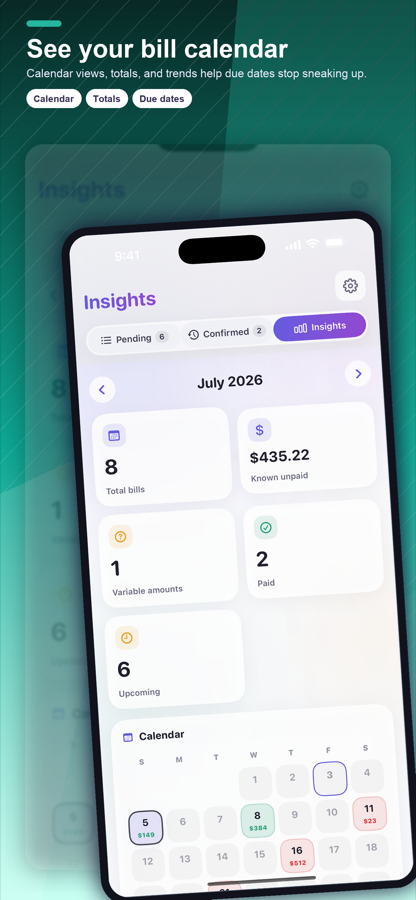
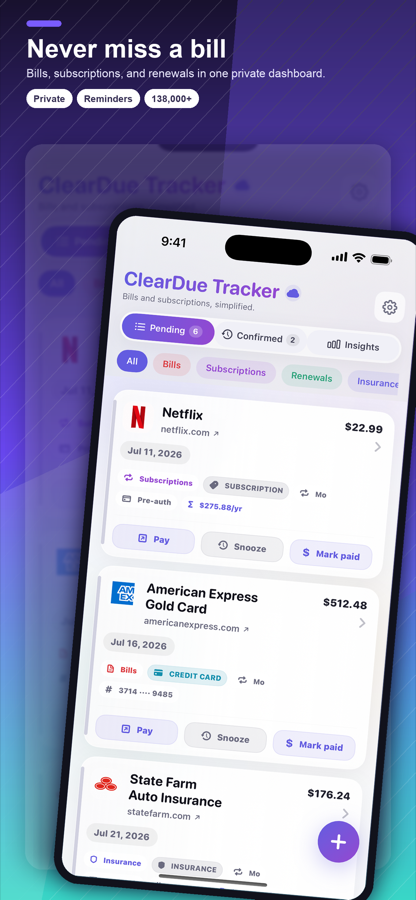
For iPhone users who want a simpler way to manage bills, subscriptions, and recurring due dates without turning the task into a bigger project, ClearDue Tracker is a good example of the focused approach. It is built around payment visibility and reminder-based organization, which is often what people need most when bills feel spread across too many places.
How to choose the right app for your situation
Start with the problem you want solved. If you mainly forget occasional renewals, almost any decent reminder tool may help. If you are trying to get a better handle on monthly bills and recurring charges across your household, look for something designed to keep those obligations visible in one place.
Next, think about maintenance. The best app is not the one with the longest feature list. It is the one you will keep updated. If entering or reviewing bills feels tedious, the system will fade and you will be back to checking email confirmations, calendar notes, and old statements.
It also helps to pay attention to how an app presents information. Some people want a straightforward upcoming view. Others want more detail about recurring patterns. Neither preference is wrong, but the app should match how you naturally check things.
Notifications deserve a closer look too. Reminders should support action, not create background noise. Too many alerts can make people tune them out, while too few can defeat the purpose. A good app gives enough control to make reminders useful without becoming annoying.
A practical standard for evaluating any bill reminder app
The easiest way to judge an app is to imagine using it on an ordinary Tuesday. You remember that the water bill is due soon, a yearly subscription is coming up next month, and you are not sure whether the internet payment already went through. Can you open the app and sort that out quickly? If yes, the app is doing its job.
That standard is better than chasing feature lists because it stays grounded in daily life. Most people do not need a complex financial platform to manage recurring due dates. They need a dependable system that reduces guesswork and helps them stay ahead.
A strong bill reminder app should leave you feeling less scattered after you use it, not more aware of how much there is to manage. That is the difference between an app you try and an app you keep.
When you are comparing options, look for the one that makes your obligations easier to see, easier to remember, and easier to manage from your phone. If it does that consistently, it is probably the right choice.