Missing a bill usually does not happen because someone is careless. It happens because the due date was in one app, the account note was in email, the renewal detail was buried in a receipt, and life kept moving. That is why a useful bill organization app review should focus less on flashy features and more on one question: does the app actually make monthly obligations easier to track and harder to forget?
For most people, bill organization is not really about finance in the big-picture sense. It is about staying ahead of recurring responsibilities without having to hold everything in your head. Rent, utilities, phone service, streaming renewals, annual subscriptions, and other repeating charges can create low-level stress when the details are scattered. A good app should reduce that mental clutter, not add another system to maintain.
A bill organization app review should start with daily reality
The best apps in this category work for people who are busy, interrupted, and managing more than one kind of recurring payment. That includes individuals living on their own, couples sharing household responsibilities, and families trying to keep routine expenses visible.
In practice, that means the app should help with the moments that actually cause problems. You need to know what is due soon, what repeats monthly or annually, what has already been paid, and which subscriptions are still active. If an app only looks good when everything is perfectly set up, it will not hold up in real life.
This is where many tools become less helpful than they first appear. Some are too broad and try to do everything. Others are so minimal that they become little more than a list with notifications. The right balance is somewhere in the middle: enough structure to keep bills organized, without turning bill tracking into a project of its own.
What to look for in a bill organization app review
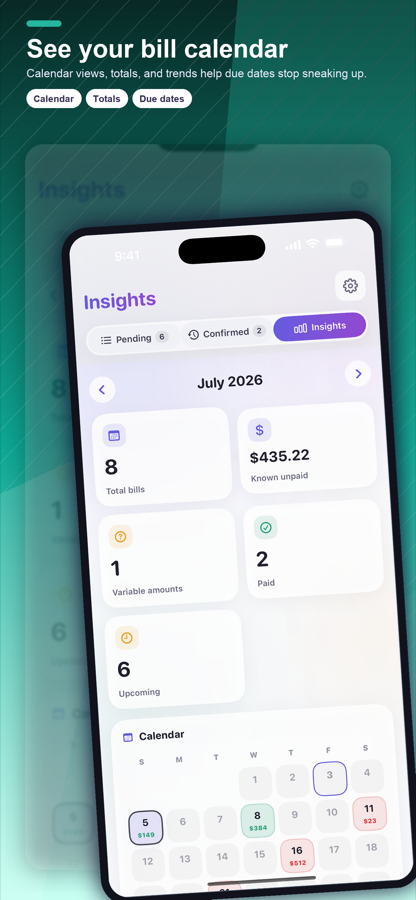
The strongest apps usually share a few practical traits. First, they make recurring due dates easy to understand at a glance. You should not need to open multiple screens to figure out what is coming up this week versus next month.
Second, reminders need to feel dependable. A bill app lives or dies on trust. If you are going to rely on it for monthly and annual obligations, it has to help you stay aware before a due date sneaks up on you. That is especially true for subscriptions and renewals, which are easy to forget because they often run quietly in the background.
Third, visibility matters more than complexity. Most people are not looking for a heavy financial platform. They want a clean way to track what they owe, when it is due, and whether it has been handled. The app should support that clearly.
A good review should also ask how much effort the app takes to maintain. If updating entries feels tedious, people stop using it. The best bill organization tools fit into a routine quickly and stay manageable even when life gets busy.
Where many bill apps help and where they fall short
A lot of bill tracking apps get one part right but miss another. Some are excellent at reminders, but weak when it comes to giving a full view of recurring obligations. Others let you log bills, yet make it hard to see patterns across monthly, quarterly, and annual payments.
There is also a difference between apps built for organization and apps built for analysis. If your main goal is to remember due dates, avoid missed renewals, and keep recurring payments in one place, you may not need charts or deep reporting. In fact, too much financial detail can make a simple task feel heavier than it should.
That trade-off matters. A more complex app may appeal to people who want broader money management. But for users who mainly need bill visibility and reminders, a simpler app often works better because it is easier to keep current.
Bill organization app review criteria for iPhone users
For iPhone users, the experience should feel mobile-first. Bill organization is one of those tasks that often happens in short moments - checking a due date while waiting in line, confirming a renewal while on the couch, or adding a recurring payment after opening an email receipt.
An app that feels clunky on mobile loses value quickly. The setup should be straightforward, reminders should be clear, and the layout should help users understand their obligations without hunting for basic information.
That is one reason apps built around specific use cases tend to feel more useful than all-purpose tools. When an app is designed specifically for bill tracking, due dates, subscriptions, and recurring obligations, it usually does a better job of supporting the way people actually manage those tasks.
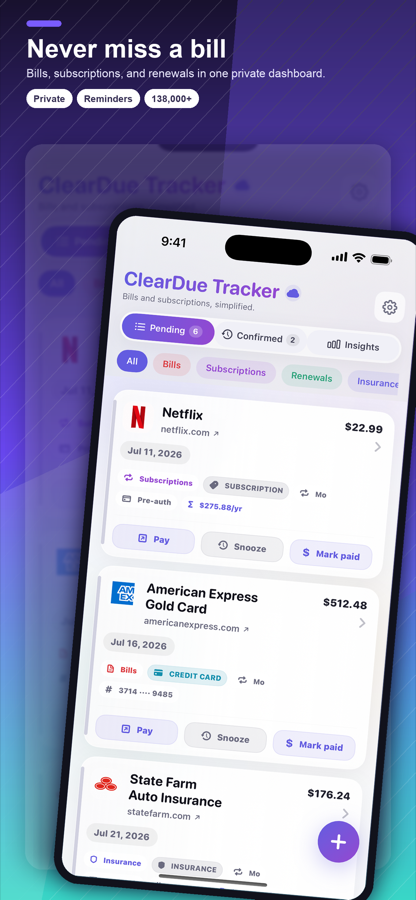
For users who want that kind of focused support, ClearDue Tracker is a good example of the category done with a practical mindset. It is built around bill tracking, subscription reminders, recurring due dates, and payment visibility, which keeps the experience aligned with the real problem people are trying to solve: staying ahead of what needs attention without relying on memory.
What separates a helpful app from one you stop using
The biggest difference is usually not the feature list. It is whether the app creates clarity fast enough to earn a place in your routine.
If you open an app and immediately understand what is due, what is coming up, and what still needs attention, that is useful. If you have to rebuild your whole system, classify every expense, or learn a new workflow before it starts helping, there is a good chance it will not stick.
This is especially true for households juggling a mix of fixed and variable responsibilities. Some bills are monthly. Some renew yearly. Some subscriptions are easy to forget because they are small. Others matter because missing them creates service interruptions or late fees. A good app should make all of that easier to oversee without feeling heavy-handed.
There is also a personal preference factor. Some users want as little friction as possible and care most about reminders. Others want a clearer record of recurring obligations over time. Neither approach is wrong, but a review should be honest about which style an app supports best.
A practical way to judge any bill app
Instead of asking whether an app has the most features, ask whether it helps with five simple outcomes. Can you see upcoming due dates clearly? Can you track recurring bills and subscriptions in one place? Can you set reminders you will actually trust? Can you tell what has been paid versus what still needs attention? And can you keep using it without it becoming another chore?
If the answer to most of those is yes, the app is probably doing its job.
That may sound basic, but basic is often what works. Bill organization does not need to be dramatic. It needs to be steady. The best apps support consistency, and consistency is what prevents forgotten renewals and last-minute surprises.
Who benefits most from a bill organization app
This kind of app is useful for more people than it might seem. It helps renters tracking utilities and monthly service bills. It helps homeowners keeping tabs on recurring household expenses. It helps couples who want better visibility without constant back-and-forth texts. It also helps anyone trying to cut down on forgotten subscriptions that keep renewing quietly.
The common thread is not income level or financial expertise. It is the feeling that too many recurring responsibilities are spread across too many places. An app becomes valuable when it replaces that scattered system with something simpler and easier to trust.
That is why the best bill organization app review is not really about rating bells and whistles. It is about whether the app gives people more control over everyday obligations in a way that feels calm and sustainable.
A good bill app should leave you with fewer mental notes, fewer surprises, and fewer moments of wondering whether something important slipped through the cracks. If it can do that consistently, it is doing more than organizing bills. It is giving you a little more room to think about other things.